reabc/Not Worker but Chattel - Ivan Kilgore/Not Worker but Chattel - Ivan Kilgore.pdf
Web PDF • Imposed PDF• Raw TXT (OCR)
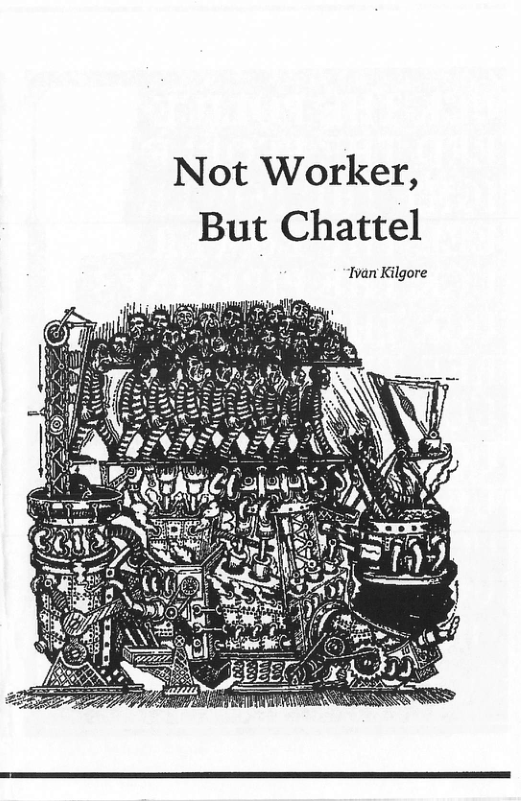
Not Worker,
But Chattel
Tvan Kilgore
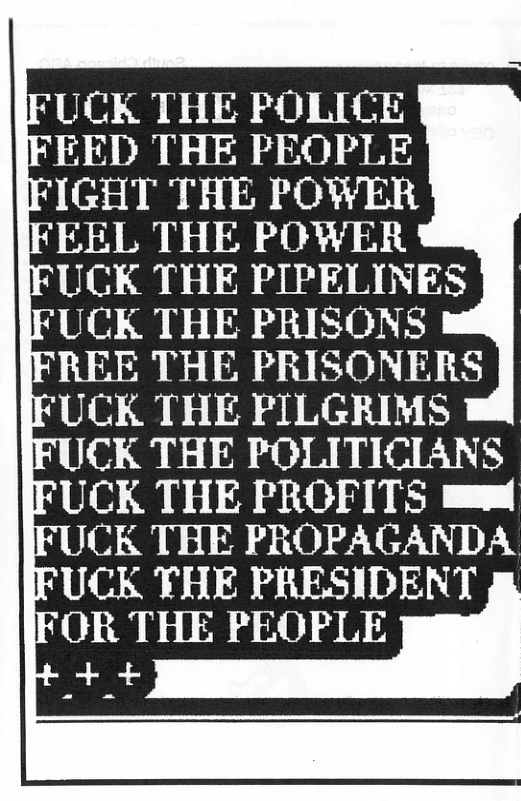
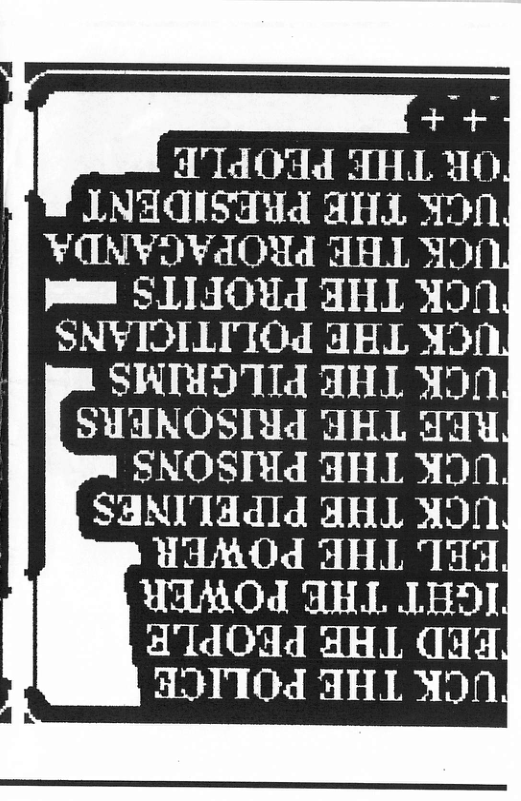
UCK THE FOLICE
EED THE PEOPLE
IGHT THE POWER
EEL THE POWER
UCK THE PIPELINES
UCK THE PRISONS
REE THE PRISONERS
UCK THE PILGRIMS
CK THE POLITICIANS
UCK THE PROFITS mmm(
CK THE PROPAGANDA
UCK THE PRESIDENT
OR THE PEOFPLE i
+ +
Not Worker, But Chattel
BYIVANKILGORE 2019
‘Whereasthe pasitionabit f the worker whther o factry worker demand-
inga monetary wage,an mmigrant, o a it wooan demanding a socal
wage)gestures toward the reconfiguration o il socet, the poskionality of
the Black subjct (whther prsrsiave o a prisos<lave-in-waiing) gs-
tures touwerd the isconfigaration of il scity.From thecoherenc of ciol
society, the Blacksubjct eckons with the ncoberenc of il war, a war
thatrecaims Blacknes et a apostio vl bt s politcally enabling
sie, o quote Fanon,of “absolute dereicton I i a“scandalthatrends vl
sociey asunder. Civl war, thr, becomes the unhought,but never forgottn,
understudy of hegemony.Itis a Blackspecer waiting in the wings, a end-
less antagonim that cannotbe satisfed (i refors o rearston), but must
nonetheless be pursued 1o the decth.
—Frank B. Wilderson I
One of the most overlooked contradietions that imprisoned aboli-
tionists face today is not merely the ssue of our resitance meeting
a master's repression, bor st a matte of fending offthe Democratic
Party's attempt to co-opt—ta steal and covertly misdirect—our ef-
forts into the legal machine of Civil Rights reform. What we prison
slaves and millions of other *prison-slaves-in-waiting™ have yet to
‘comprehend s the extent to which an inteznal ideological struggle
‘must be waged amoing ourselves, within a segregated prison populs-
tion, s wellasin our neighborhoods and commanities, fwe are ever
to realize our potential s revolutionary clas.
‘What [ convey in the following essay is particular lesson re-
garding what Hortense J. Spillers calls “the intramural,” derived
from my experience organizing side-by-side with fllow US. prison
slaves. Itis a story about the white supremacis state's use of depri-
vation, terros, seduction, and organized treachery as tactics to
‘maintain compliance and ‘rdes’ among the imprisoned masses. It s
a story of the past and an analysi of the present, to clrify the tra-
jectory for our struggle moving forward—without promise, without
‘confirmation of an eventual justce, drawing only upon our collée-
tiveabolitionist fath. In what follows, argue that Black abolition-
st politic—a set of beliefs and practices formed in opposition tothe
‘white supremaclst state;struggles for e and death initiated by and
for those Inhabiting the social position of chattel property—must
‘both be definitively against "work” and agalast defining ourselves as
“workers As & number of Black Studies scholars write, there are
fundamental differences between the polltcal category of the
“worker” and that of the ‘slave.”
Rendered civilly dead by US. law, 1 am o the State asthe slave
Was to the plantation Master. The same relation of coercive racist
violence appies: my Black body isalways vulnerable, open to m en-
veloping State terror. As propesty of the Stae, exist in direct can-
frontation with the puniive core of capialist relations of force.
Every movement | make carries with it the possbility of authority's
lash. I am the bodily raw material that gives the prison industrial
‘complex purpose and social meaning. Beyond recognizing the struc-
ture of violence that L inhabi, it should also be noted how the very
act of naming myself—a slave held captive by the State—as “wocker”
ensbles various tactics of seduction which operate to displace the
gravity of the situation. Because job assignments are seen as a ela-
tivepriviege behind these wall, we are lured into conformity and
‘compliance to work, often merely out of a need to survive. While I
discussthisLatter dilemma for the majority o this essay, | would first
ke to begin by unpacking the former, clacifying the structural posi-
thon ofthe (prison) ave. -
L
‘There are two essentlal dilemmas that prisoness face when organiz-
ingas the worker-on-srike instead of the slave-in-revol. Onels that
a prison strike must be organised differently, its operations con-
ducted diffeently, and requires a level of active solidarity (from
others not i our posiion, non-imprisoned people) fr greater than
‘amy other united workplace action. Many on the outside need totake
‘up more ofthe risk. For example, there are mumerous ways that free-
‘world people can participate ina prison strike that does not mistale
symbolic action for direct, disruptive tactics. We need mass civil dis-
obedience, not more divic performance. Jf our goal i to clog the ar-
teries of the prison regime from within, it might be more efective to
‘choose methods that nterrupt the prisor's reproduction from with-
out. While we are staging si-ins, boycotts, soppages, and refusing
trays inside,fee-world activists could oecupy the offices ofa Degart-
ment of Corrections, stage protests at a prison werden's prhvate
house, or stage sit-ins in the buildings of government instirutions
and corporations that benefit from the smooth functioning of the
prisoncrat’s political-industrial machine. As an outside comrade
once pointed out, “phone zaps”are effecive ia cesain historical sit-
wations, but disrupting this fascist regne requires a whole lot mare.
As Frank B. Wilderson argues,the worker i exploited at best,
‘et only shot, brutalized, or imprisoned because they engage in sab-
otage or forceful strike. The slave however Is rendered the object of
gratultous violence as a perpetual structural constans. By missing
this point and defining ourselves as imprisoned “workers,” we open
ourselves up to the public’s misrecogaition of the levels of risk in-
olved with organizing on the inside. The universalist category of
the worker also fails to grasp the centrality of our captivity to the
‘making of US. soclety’s sense of (racla) feedom and (white) civil-
zational ascendency over the wretched of the earth. This, in fact,
‘brings me to my second pai, a thing much more complex to ex-
plain, That s, the factthat our enslavement by the State holds cul-
‘urally specific purpose for the society that appears driven to physi-
eallydisappear us.
I the antebellum South, plantation slavery was not only an
institution for the production of material goods at a cheap cost for
the rling cass. Slavery established the very structure through which
‘white freedom was, and is, made legible. The machinery of slavery
was foundational to the non-slave’s experience of freedom at 3
poycho-sociallevel. In fact, there would be o meed o use the word
“freedoma” a all had these ot firs been the creation of structural
‘position called the Slave. I kas always been white freedom and life
‘roduced in opposition to Black unfreedom and death.
State power i not only repressive but productive of social re-
Lations. I creates traps that lure usinto complicity and participation.
whetheritisfor our own benefit or not. We need to understand work
in prisons as such, and promote an abolitienist politic that is pro-
foundly anti-work. We can't see the struggle as merely a ight for
etter wages, becatse the majority of us doa't have wages atall. We
‘have to abolish the appasatus that cages us, separates s from our
familie, and disappears usfrom our commumities. We need a move-
‘ment that thinks not only in terms of abar/economics, but a move-
‘meat that challenges the carceral foundations of the white suprem-
acit state.
Often when Ll felow prisosers of my reluctance to work in
‘one ofthe many prison factoses o so-called Job assignments” | am
Tooked wponas i1 have sid something foolish. They slvays deferto
the question of “Why™ As f being exploited for pennies on the dol-
lar or 20 wage at allfor aur.labor s an acceptable situation. In an-
swering their question, | explain to them my experiance in the Sem-
inole County Jail in Wewoke, Okizhoma.
For twenty-three months, 1 wes trapped in that Barney Fife of
a bellhole, Bghting for oy life on a eapital murder charge. It had no
‘commissary. No TV or radio. No outside cell activity. No Hbrary.
Nothing. We were housed six to a cell, and all we had were our
buks, a few card games, and what fw books we could get our hands
‘on. Lunch was reheatad for dinmer and, reedless tosay, the food was.
teribl. So tareible tha almast tweaty-fve yearslater I stll an taste-
that stale Thursday morning breakfst. It was degrading; an army
ration of dehydrated ham and egg. Mixed with a litle hot water It
‘swelled up ike dry dog abit on a rainy summer day. Afer fushing it
‘down the tollet for about six moaths I inally relented. When you
lose thirty pounds from starvation you begin to acquire a taste for
thissortof hit.
Of course,the trustees (Le. slaves with “work privileges”) were
allowed to watch TV, listen to radio, and to use the soda machine
‘upstains in the courthouse. Every now and then, the jalor would also
allow one of them to go across the stret to the Dollar Geneal to
purchase candy, underwear, deodorant, or some other miscellane-
‘ous item that seemed to make e tn that shit-hole that much more
tolerable. (In case you're wondering, the only clothing the Jal pro-
vided were the oversized, bright orange umpsuits; no coats, under-
wea, et.. They also were allowed a hug and kis from thelr viitors
‘and, on the weekends, they worked malatenance on the courtyard.
As for the rest of s, we were allowed nothing. No commissary,
0TV, no outside cel activity. Nothing. Old cornbread, wrapped in
‘some tollet paper wrapper, was the aoly the thing we had to eat that
kept our stomachs from growling at night. Man, how I wished to be:
2 “trustee” during those days. The “perks” alone made it to where
‘nobody in thatstuation, Including myself, cared that we werei fuct
‘eing paid nothing for our labor.
For twenty-three montb, [ was forced to live under the fore-
going conditions, wanting nothing besides freedom, and willing to
slave st to get a smalltaste of i, Yet because I was charged witha
M (e, 1-degreee-murder-charge) and would later face a'Geath
‘penalty tral, there would be no lstening to country music o enjoy-
ing the sliver of mobility awarded toa trustee.
Looking back on that situation today, I cannot help but think
of how unfreedom and “gut” starvation conditioned me. | internal-
ized 50 much stress, fear, and anger that it tempered my spirie. 1
filed to even realse how profoundly it suspended my reluctance to
‘workin a carceralsetting, Essentiall, | was disciplined to withstand
the taunting effects of my incarceration which prompt so many of us
slaves to relent to the illusive “perks” associated with prison labor
anda life of hardscrabble.
Eventually, I was able to place those so-called perks tn thelr
proper perspective: They were but a distraction, misplaced values
and desires | had yet to conquer; things that | had been manipulated
t01hold In esteem that, with exception of food and exercise, were not
‘mecessarily needd to sustaln lfe. They wera but a carrot-on-a-sick,
an inducement used to exercise power over my being by misleading.
meto belleve they were pevileges.
et because I could not value a privilege did not have, or be
‘made cantent by it, the power my captor saught to exerciae over me
was ineffctive. Little did I realize at the time how this enabled me
0 see my situation for what it traly was—a grave injustice—and re-
spond accordingly. Instead of submitting to the distraction and at-
tempting to ameliorate the harsh cooditions of my iacarceration
‘with an llusive pork, I learued how to use those conditions as &
souzoe of motivation to Sght for my feedom and just treatment.
Inshort, | TURNED UP!
Food trays were thrown a the jalors and trustecs. Mattresses
busmed, The entire il fooded, and the power short-<ircuited. 1 fred
attomeys left and right, and began the processes of leaming how to
represent myself n coust. Ultimately, | won and was back on the
streets fn 36 months,
In time, | was ta discover my experience in Oklahoma was not
typical compared with most county il and prison systems ereatod
by thissettler colonil nation. To put it mildly, the Seminole Couaty
Jailwasa relic of the Old Sonth, where doing time was and stillis, in
many 2spects, harsh and unbeasable.
‘Years later, when I was committed to the California Depert-
‘ment of Corrections and Rehabilitation (CDCR); ane of the first o
‘many cellies 1 was to have over the years called himaelf sehooling me
‘on the husdle and pesks of prison work assignments. The perks, he
explained, ranged from something as simple as stealing extra food
from the kitchen, to manipulating staff for sex and other contra-
band” Indeed, the inducement to work seemed to have is ad-
vantages.
However, s he explained al o this, I could not help but think
that while he meant no harm with his adice, he was thirking ass-
backwards. At this point, he had done almost twenty calendar years.
And what he was kickin' to-me was hustling to be content with his
lifein prison and being “penitentiary rich." As time passed and we
‘begame bettar aquatinted with one another, | eventually pointed out
‘to bim that neither the “perks” or anything he had hustled for in.al-
‘mopt 20 year of being incarcerated has purchased.his freedom, ox
reted any kind of financil stablity either inside or ontside these
‘walls. I explained that hustling in prison, moress than hustling on
the brick, s shortlived. I¢s comer husting at its wors, dealing.
‘ith shifty-ass scavengers, opportuniats and scalawags—REAL LIFE
'DOPE FIEND SHITI Where snitching s at an all-time high and its
hitvand-miss inconsistent game where the hustlers, often more than
wind up in the “hole” with more time, restictions, and must
iving their huste stacks back to the canteen or thelr ovn
bablt. .
Despite haviag explained all this, nane of it seemed to register
‘with him or countless otber prisoners who, because of a lack of pro-
ductive opportanities, confidence, knowledge, discipline, and plau-
sibility of nstant gratification, disregard the odds and relent to the
bullhit.
+ In time, I observed that it wasa't even about the hustle and
‘perk for most peisoners. Many were simply looking for an ecape
from the daily monotony of an otherwise dzab mistence. Prisons, we
Jnqw, ae idle and mundane places. They are isolating. And the ma-
joriy of us do not have the fortune of frequent, o sy, interaction
with the outside wosld. Therefore, to be able ta get out of the <ell to
‘work—especlally In @ maximum secucty setting—and to be able to
fraternize with other lnmates or staff—especilly those staff who are
‘comfortable sharing their lfe expeciences, which many prisoners
bave yetto have, i ever they will—is vicarously aad peychologically
reviarding ia and ofteelf,
Having observed the foregoing, it became abundantly clear
that while the majority of us are conscious of the fact that our labor
isbeing exploited, the value we have come to place ona wark assign-
‘ment has been manipulated by the structural environment created
by prison offical. To this end, we know prisans are purposefully
designed to be cruel and urusual places. And despite countiess court
rulings ameliorating the abuse we frequently encounter at the band
of prison administrators, the inteat remains to maintain oppressive
conditions that, in effect, aim to keep us Impoverished, dependent
and, thus, powesless. Consequentl, this has give i to the culture
that we subscribe to where, for eample, pushing a broom on the tier
for 20 years with litle to no compensation is accepted s a norm s0
Iong a8 we may entertain the liusion of a *come up.”
I
“Netther savery nor nvoluntary servitade, except s & punishment
for crime whereof thepartyshall have been duly convictel,shall exist
within the United States,or any placesubject o therfurisdiction”
—13th Amiendraenstofthe United Staes Constituion
“Prison slavery” over the past decade has gained traction as a key-
‘word in activist vocabuleries and progressive popular culture. Some
‘people use the term to deseribe the conditions of cheap o literal
indentured labor that | discuss above. Yet over time, it has taken on
2 new and mone adequate reaning refering to e generalized con-
dition of a prisoner's social death. Slavery in this theoretical context
i the legally-sanctioned and state-condoned project of containing
and dissppearing certain targeted and criminalized populations—
the social condition that animates the machinery of the U.S. Prison-
Industrial Complex; a white supremacist regime with its own sepa-
rate drives that exceed the demands of wealth accumulation. Of
course, punishment has been industrialized as a means to manage
various (criminalized) surphs populations, those deemed unquali-
fied orineligble for even the most exploitative of waged occupation.
‘Yetatitscore modern prison slavery isalso predicated on a distinctly
white supremacistlogic of extermination
‘The Thirteenth Amendment, aecording to this argument, is 2
legal techmology that hasanchored U.S. geopolitical power ina foun-
dation of Black genocide. This mass of white supremacist violenceis
‘ot confined only to the physical site o the prison/jal itsef, butis
also a basis for the white settler's entire conceptinn of himself as
“free;” as the proper subject of “rights” as the allegedly peaceful
‘guardian a “democratie” social order i the remova o ereninal-
ized populations from white civil space that enables the U.S, settler
to think they are free. The structural violence of prison slavery is
thus modeled on the master-over-slave relation, yet in the present
‘erait has been transfigured into the state-over-convict relation. The
latter figure is effectively evisceratod of all “rights” undar law and
‘placed ina position of government:-imposed civl/social death.
+ Inaou, Free Alabama Movement co-founders Melvin Ray, Ki-
‘metic ustice, and 1 were discussing the prospect of kicking offa "Free.
California Movement” in which California prisoness would foin the
international movement to sbolish prison slavery. My initial re-
‘sponse was, “IYll never work in Call.” Why? To be clear, in no way
‘Was my response a reflection of my own disposition, but rather it was
a reflection of the many conversations | bave had on the subject over
thepears with fellow prisoners.
1 . Time and time again, what they say s, “Man... | ain't got not
‘outside support. I can't risk losing my job. That 510, 50 and, in some
‘cases $200 pay number, countsi™ or it’s “T'm trying to ‘come up't”
And [ can't forget the chowhall workers. They like to eat! Is that
simple. (And tha’s not to mention howall the recent changesin law
‘that now provide eamed time credits and parole eonsidesation have
impacted them in such a way that “protesting” anything is the last
thing they're concerned about). For them the inducement to work is.
‘simply oo strong. Then, of course, there are those who honestly be-
lieve they owe a debt to society. Therefore, they see nothing wrong
with the enslaverment.
Al this Melvin and Kinetic Justice couldn’t believe. They were
simply astonished and under the impression that there would be 3
strang resistance to injustice within California's prison population,
on account of George Jackson's legacy and the 2on/2013 hunger
strikes in which a reported 30,000 prisoners protested the renegade
‘aduiinistrative process that landed countless peaple in the SHU in-
defoitely.
To my dismay, had to explain to themthat the hunger sries were
2 gradualist reform movement, not a militant abolitionist move-
‘ment;that they had nothing to do with abolishing prison slavery ar
‘genocide more generaly; that e majorcy o prisoners in California
‘would view a general strike as counter-productive to their own self-
ish reasons for working in a prison setting, and like prisoners any-
where many simply lacked the necessary vision, discipline,
Inowiedge, and willingaesn to sacrifce those crumbs for the bigger
picture.
Havig said that, I've noticed a slight change of disposition
‘amongst many prisonersin California. Before and during the hunger
strkes, many were doubtful, I not pessimistic, as to our ability to
bring about change and abolish many of the oppressive and fnhu-
‘mane aspects ofprison. However, ater the bunger srlkeslead to the
3015 settlement in *Ashker v. Brown," which supposedly abolished
indefinite SHU terms, the conversation on the yard has been some-
‘what optimistic. That said, the most significant resuk of the hunger
stikes was not foreing CDCR to reform its bogus gang validation
process and indeterminate SHU scheme, ather it was the cultivtion
of faith that we as prisoners—as a collecive and enslaved political
body—have the power to dismantle the oppressive and inkumane
circumstancos we find ourselves in.
In essence, the hunger strikes exemplified what abolitionist
Ruthie Gilmore describes as the mobilizaton of the forms of dual
‘power aeady latent in colonlzed and oppressed communities; the
disruptive potential of organizing ourselves as rebel slaves. She ex-
plains:
Power is nat a thing but rather a capacity compsed of actie and
changing elationships nablinga person, group,oristicion o com-
el others to do things they would ot do on their owm (such as be
nappy r pay taxes,or g0 0 war. Ondinarly, activits focus on taking
‘power, as though the entre poltica setup were relly a matter of St
(tructure) verss s (agency. Bu f thestrucaure-agency apposition
n't actually how things really work, then perhaps pofts is more
1 complcted, ard herefor pen t nore hopeful acio. Foplecan amd
domakspaver through, for exampls, deveeping capecies i rgen-
. aations. But that's not enough, because all an individual organtzation
can doon s oun i ek Aragdon. When the capecisresuting
from purpasefu action are cambined toward ends greater than mission
Satementsor otker provisnal e, piweful abgrment begn to
Shaketh round. In cther o, movement hppens.t
As emblematic as the humger strkes were in demonstrating how
counter-state forms of power are fortified, which Gllmore argues
succinetly In the above passage, we still have our work cut outfor us.
‘The entire structure of prison elavery/gengcide must be challenged
asawhole. [believe it is impartant that we acknowledge the policing
and imprisonment regime as the central target we rally around and
develop the capacities of ‘powes” that reside—dormant, ahways—
‘within our commuities. Justas it took slaves refusing trays, street
protestors, progressive awyers, university workers, and many others
© bulld the 20m/13 resistance and provide documented evidence
thatlong term solitary confinement s psyehologieally damaging and.
“cruel and unusual punishment,” 8 too wil the same effort be re-
quited to demonstrate that prison slavery in fact is progremmatic,
lowsiatensity Black genocide more gerierally.
‘Notably, the recent 2016 and 3018 nationwide peison strikes
show promise. But we need more. We need to build a mass move-
‘meit that wages an offensive for genocide abolition. Whatis needed
is mot merely slavery abolition, but the abolition of the prison 2s 2
lethil mechanism of soclal death. We must resist the sedustions of
‘workinan envisonment of forced isolation and (the always-present-
‘potential for) extermination. In turn, we must not misconstrue our
status as mere exploited workers, or model our operations on the
lesaons of seiing wage workes. The postion of the (prison) save:
s a structural juncture of improvised unity with which we can all
rally bekind, whether locked in the gulag already, or as peoples
struggling together on the outside to avoid/defend-against/abolish
the posaibility of capture. There is a power that we can utilize, a
‘power that can be unleashed in the domino effect of the revolting
slave. Thisis how Black politcal onsclousness s formed—from the
everyday to the extraordinary,in the anti-diaectic between master
‘and slave, we continue to build the grounds upon which the former’s
disintegration becames imperative. The ehattel coavict i thus from
the moment of arest positioned i such a way as to develop Black
‘politics as imprisoned people are ll subjected to the gratultous ter-
ror of the sate. We are ot workers for the most part. We are en-
slaved. Captive. Captured. Property ofthe U.S. nation state, The raw
‘materials disappeared to give shape to white demoeracy's freedom.
Free world abolitionists will you join in the dance with social death
Endnotes
1. Frank B. Wilderson II, “The Prison Slave as Hegemany's (Silent)
‘Scandal” Social Justice vol. 30, no. 2 (2003):26.
‘Gramumar Book." diacides 1987, Bp-
3. For more on the concept of Togic of extermination,” See: Dylan
Rodriguez, Forced Passages: Imprisoned Radical Intellectuals in
the US. Prison Regime. Minneapolis: University of Minnesota
Press, 2006.
4 Ruth Wilson Gilmare, Golden Gulags: Prisons, Surplus, Crsis,
and Opposition in Globalizing Californic. Berkeley: Universty of
California Press, 2007.
5. Frank B. Wilderson I, Red, White and Black: Cinema and the
‘Structure of U.S. Antagonisms, Durharm; Duke Uriversity Press,
2010,
F ++
ITdOHd THL 9O
INFQISTId 0L 10N
VANYOVJOUd HHL YD
S 11J0Yd HL M0N0
SNYIDILI'TOd dHL M0
SHIMITId AHL ¥DN
SYINOSIYd HHL T3y
SNOSIHNd IHI ¥DN
SANITAdId AHL D1
HiMOd AHL T49
HIMOd AHL LHII
d'1dOdd HHL a4
HHTOd FHL XON
o
a
< o
SA 8
= o
o
2
£NQ
2 o
3
o A
Ok
ol
s
Homewood, IL 60430